
Day Program or Building Skills at Home?
One builds skills in a group and gets you out of the house. The other builds them where you use them. Which fork suits which person.
2 September, 2026 · 5 min read
The real difference is where the skill gets practised
A day program builds skills in a group, away from home, alongside other people. One-to-one capacity building at home builds them in the kitchen, the laundry and the local shops where they will actually be used. Both are legitimate, both can sit in a plan, and the choice is less about which is better than about which setting the skill needs.
Put crudely: if the goal involves other people, the group setting is doing part of the work. If the goal is a task in a specific place, the place matters more than the company. Cooking a meal you will cook again is a kitchen job. Learning to hold a conversation with someone you did not choose is not.
What a day program gives you that home cannot
Other people, a reason to leave the house, and a week with a shape to it. The social side is not a bonus feature bolted onto the skill building, it is often the main event, particularly for a school leaver who has just lost the entire social structure that school provided.
There is also the plain fact of separation. A young adult who does everything with family or with one worker has no part of the week that is theirs alone, and no stories to bring home. Our hour by hour look at a day in a day program shows what that day actually holds. Group settings come with ratios, though, and a ratio decides how much attention any one person gets, so it is a fair question to ask before enrolling.
What one-to-one at home gives you that a group cannot
Attention, and the right room. A worker beside you at your own bench, using your own appliances, means the skill transfers on day one instead of having to be translated from a training kitchen. For anybody who finds noise and crowds costly, that difference is enormous: the energy goes into the task rather than into coping with the room.
It also flexes. Two hours on a Tuesday and a Thursday can be pointed at whatever this month needs, which suits somebody rebuilding a routine after a hospital stay, a house move or a change in health. What in-home support looks like day to day covers how those hours are usually shaped.
The honest cost is loneliness. A week made entirely of one-to-one support can be a very quiet week, and no amount of good skill building fixes that.
The four questions that decide it
Is the goal social or practical? Friendships, group tolerance, being out in the community: group setting. Cooking, laundry, money, transport on a specific route: home and neighbourhood.
How does the person handle a busy room? Not whether they can manage it, but what it costs them and what is left afterwards. If a group day means two flat days after it, that is your answer.
What does the rest of the week look like? Somebody living alone with two support hours a day needs the group. Somebody in a shared home with housemates and a busy roster may need the quiet one-to-one time more.
What is the funding actually for? Group programmes and one-to-one skill work sit in different parts of a plan and are quoted differently. Ask which category is being drawn on, and read the NDIS Pricing Arrangements and Price Limits rather than assuming an hour costs the same in both.
Most people should stop choosing and do both
The framing as a choice is usually wrong. The arrangement that works most often is two or three days at a programme for the people and the structure, plus a couple of one-to-one hours at home aimed at one specific skill at a time.
Split weeks need one thing to work, which is that the two sides talk. The goal being worked on at the programme should be the goal being practised at home, or you get two disconnected efforts and no visible progress. Ask both providers to write the same goal down in the same words, and ask each of them what the other is doing about it.
Give it a term, then judge it
Whichever way you start, set a review date about three months out and decide in advance what progress would look like. Not a feeling: a task done with less help, a morning that no longer needs prompting, a person spoken to voluntarily.
Then change it without drama if it is not working. Trying a day program and moving to home hours is not a failure, and neither is the reverse. If you want to see the two side by side before deciding, our day program page sets out the week, and our in-home care page covers how the one-to-one hours are built.
Want to talk this through for your situation?
More from the blog.
-
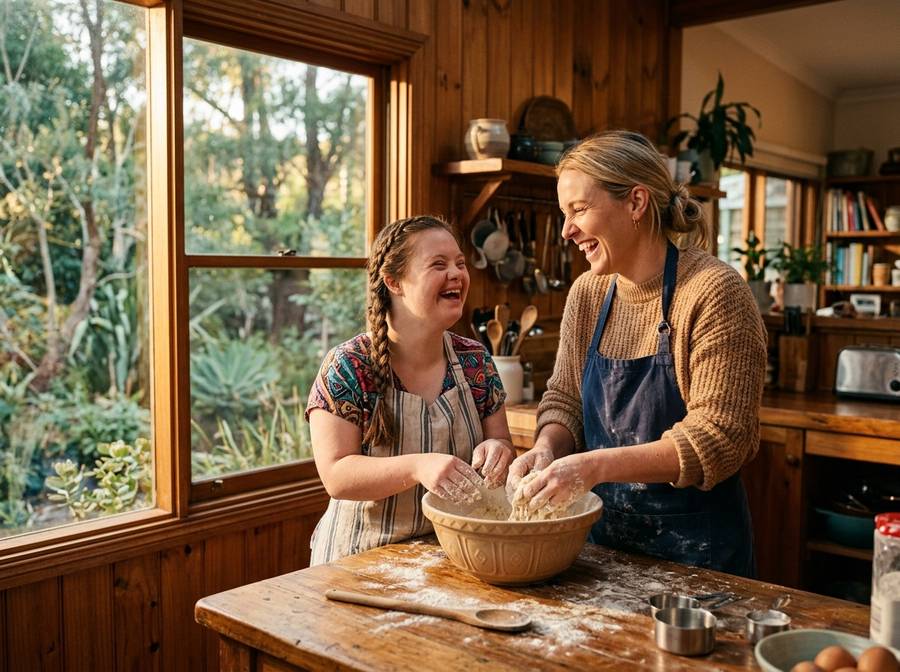
A Day in an NDIS Day Program: What to Expect
Wondering what actually happens in a day program? No two days look the same, but here is the shape of a typical one.
Read article -

Building Real Life Skills Through Day Programs
Day programs are about far more than filling a day. Done well, they build the practical skills that lead to real independence.
Read article -
What a SIL Vacancy Listing Really Tells You
A SIL vacancy is one bedroom in a house that already has people in it. Here is what a listing tells you, and the four things it never says.
Read article
Let's find your place.
Speak with our team about vacancies, supports or day programs.