Why Newer Suburbs Are Often Easier to Get Around
Master-planned estates tend to have wide, continuous footpaths and consistent kerb ramps. They can also strand you without a car. What to check.
24 August, 2026 · 5 min read
What newer streets get right
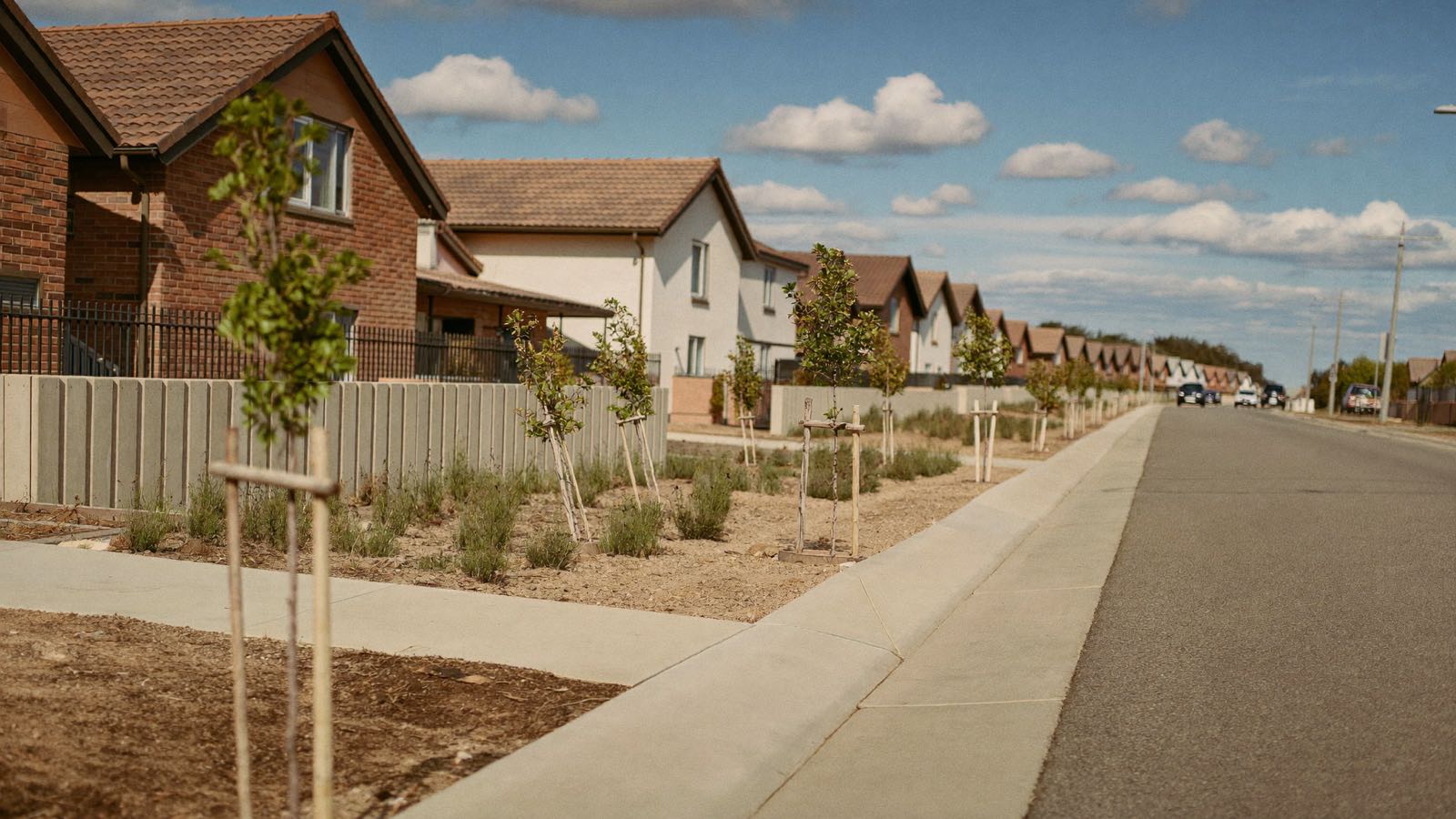
Suburbs built in the last twenty years were laid out under current standards, and it shows on the ground. Footpaths are wider and usually run the full length of a street rather than stopping halfway. Kerb ramps appear at corners consistently instead of at whichever corners were rebuilt most recently. Driveway crossings are gentler. Surfaces are newer, so there is less of the tree-root heave that turns an older footpath into an obstacle course for a wheelchair or a walker.
Older established suburbs often have better transport and better shops, and worse ground underfoot. That trade is the whole subject of this article.
Two real examples of the trade
Jordan Springs, in the Penrith area, is a master-planned community with wide streets and consistent footpaths, and a village centre and lake with walking paths close by. It also has no railway station. Werrington and Kingswood are the nearest, Penrith is about 4.4km away, and bus routes 673 and 783 do the connecting. Getting out of the suburb generally means a bus or a lift.
Edmondson Park, in the Liverpool area, was planned around its station rather than beside one. The station opened in 2015 with lifts between street level, the concourse and the platforms, staffed from 6am to 7pm daily, and Ed.Square town centre sits right beside it with a supermarket, shops, cafes and a cinema.
Both are new. Only one of them lets you leave without arranging a car. That distinction matters far more than the age of the footpaths, and it is the first thing to check.
The checklist for a suburb you are considering
Walk it, do not map it. Satellite imagery does not show you a missing kerb ramp, a footpath that ends at a fence, or a crossing with no audible signal. Half an hour on the actual ground answers more than an hour online.
Then check these specifically. Does the footpath run continuously from the house to the nearest shops, or does it stop? Are there kerb ramps at every corner on that route, on both sides? Is there a signalised crossing on any road that has to be crossed, and does it have enough time on it? How far is the nearest bus stop, is there a shelter and a seat, and how often does the bus actually run on a Sunday rather than a Tuesday? If there is a station, does it have lifts, and is it staffed at the hours you would use it?
One more that gets missed: gradient. New estates are frequently built on ground that was never flat, and a beautiful wide footpath on a long slope is harder work than a narrow one on the level.
What the newness costs you
Services lag housing. A new estate can have excellent streets and a thin bus timetable, few GPs taking new patients, and the nearest allied health practice twenty minutes away. Those gaps close over time, and 'over time' can mean years.
Community takes a while too. Older suburbs have clubs, groups and a library that has been running for decades. A newer one may have the building and not yet the programme. Worth asking what actually runs, not what the community centre could host.
And shade. Young street trees are not yet trees. On a 38 degree February afternoon, a wide unshaded footpath is not accessible in any practical sense, which is a real consideration for anyone who overheats or fatigues quickly.
How to weigh it up
Decide which problem is the harder one for the person actually living there. If the daily obstacle is uneven ground, a newer suburb solves a real thing. If the daily obstacle is dependence on someone else driving, a newer suburb without a station makes it worse, and an older suburb near a line is the better answer even with imperfect footpaths.
Our guides to Jordan Springs and Edmondson Park set out the transport detail for each, and the full list of homes lets you compare areas side by side before anyone visits anything.
Frequently asked questions
Are newer suburbs more accessible than older ones?
Usually on footpaths, kerb ramps and street width, because they were built to current standards. Often not on public transport, shops and services, which take years to catch up with housing. Which matters more depends entirely on whether the person living there travels independently or relies on someone driving.
What should I check on a visit to a suburb?
Walk the route from the house to the nearest shops and the nearest stop. Look for continuous footpaths, kerb ramps on both sides at each corner, signalised crossings with adequate timing, bus shelters with seating, and lifts at any station. Check weekend timetables, not just weekday ones, and note the gradient.
Does a new station always mean step-free access?
Stations built or upgraded recently generally have lifts, but staffing hours vary and that affects assistance availability. Edmondson Park station, for example, has lifts between street level, concourse and platforms and is staffed from 6am to 7pm daily. Check the specific station on the Transport for NSW website rather than assuming.
Want to talk this through for your situation?
More from the blog.
-

Getting Around South West Sydney Without a Car
Which south west Sydney suburbs have a station, which are bus country, and how NDIS transport, Opal and the taxi subsidy scheme fit together.
Read article -

Living in Macarthur with an NDIS Plan: An Area Guide
Campbelltown, Narellan, Macquarie Fields and Camden from a participant's point of view: hospitals, transport, learning and where the homes actually sit.
Read article -

Preparing for Your First NDIS Planning Meeting
The meeting rewards preparation more than eloquence. Bring a week in writing, name the goals plainly, and know which questions to ask before you leave.
Read article
Let's find your place.
Speak with our team about vacancies, supports or day programs.